

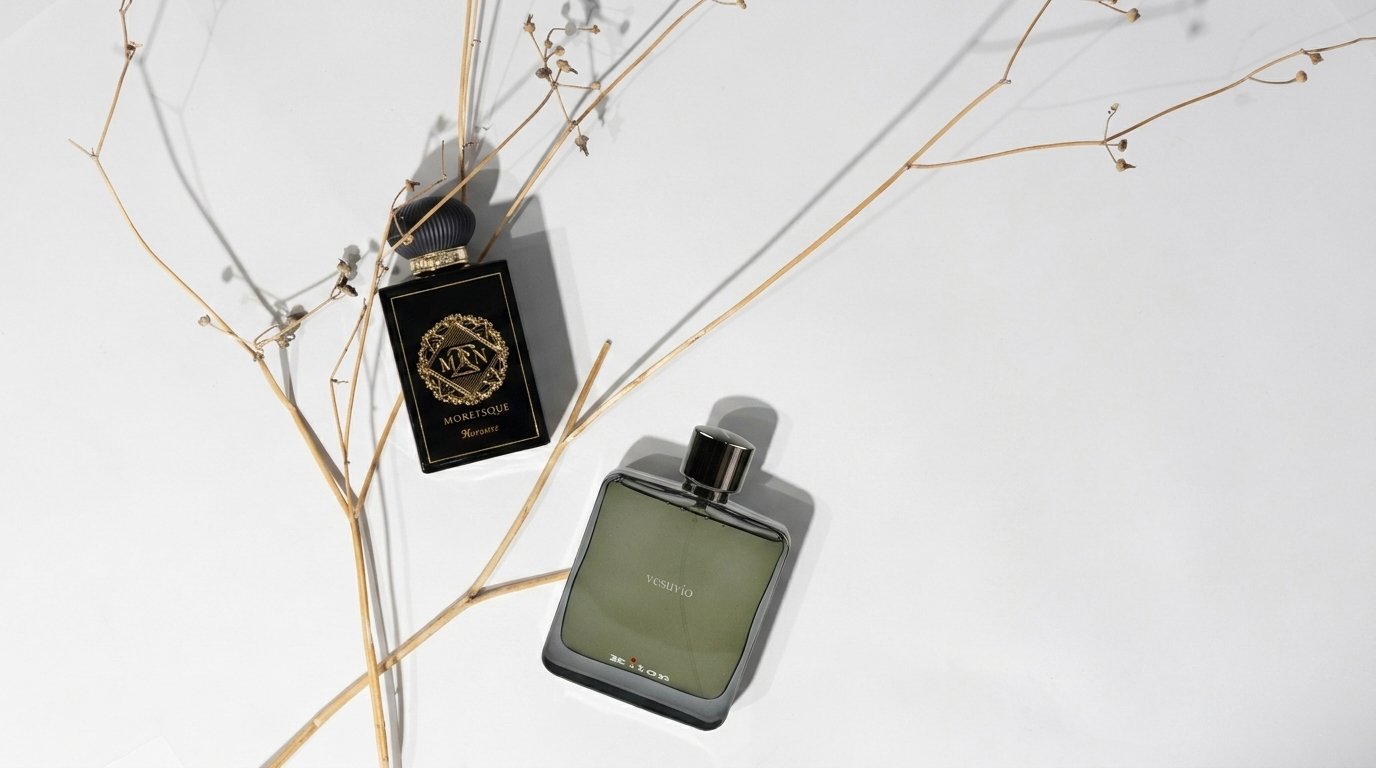
How to Match Your Fragrance to Your Sartorial Look — The Italian Art of the Complete Gentleman
Studies indicate that 75% of all emotions generated daily are triggered by smell rather than any other sense — a fact that the Italian sartorial tradition understood long before data confirmed it. The suit is pressed, the shirt is immaculate, the shoes are mirrored, yet the man who neglects his fragrance has left his composition unfinished. Scent is the invisible signature that precedes you into a room and lingers after you leave. In the lexicon of Neapolitan tailoring and Milanese elegance, choosing the right eau de parfum is not indulgence — it is discipline.
This guide moves through the full art of fragrance-to-outfit pairing: from understanding the major olfactive families — woody, citrus, aquatic, oud, amber — to reading the weight and register of your cloth before you reach for the bottle. Whether you are settling a Sartorio Napoli dark-blue virgin-wool suit across your shoulders for a board meeting or sliding into a linen blazer for a Saturday aperitivo in Capri, the correct fragrance completes the picture with the same authority as a perfectly knotted tie.
"A fragrance is not worn on the body — it is worn over the suit. It is the final note of a composition that began the moment you chose your cloth."
Explore the full fragrance edit at iSuit →
Key Takeaways at a Glance
| Situation | Outfit Register | Recommended Fragrance Family | Signature Note |
|---|---|---|---|
| Business meeting | Dark wool suit | Woody / Amber | Sandalwood, vetiver |
| Formal evening | Evening suit / tuxedo | Oud / Deep floral | Oud, rose absolute, musk |
| Weekend casual | Summer cotton / linen | Citrus / Aquatic | Bergamot, sea salt, neroli |
| Country weekend | Tweed / flannel | Aromatic / Fougère | Lavender, oakmoss, cedar |
| Important evening | Fine wool 150s suit | Sensual / Amber | Warm amber, patchouli, tonka |
1. Fragrance as the Final Layer of the Look
Italian tailoring operates by a philosophy of total coherence. Every element — the drape of the lapel, the roll of the chest, the fall of the trouser — is chosen so that each part reinforces the others. Fragrance belongs inside this logic, not outside it. The moment a gentleman applies a scent that contradicts the register of his cloth, the spell is broken. Conversely, the right eau de parfum elevates even a modest suit into something memorable.
When the cloth is heavy and authoritative — a dark-blue virgin-wool suit by Sartorio Napoli, cut in the soft Neapolitan tradition with a suppressed chest and open quarters — the fragrance must possess comparable gravity. Light green or watery accords dissolve against such fabric. The notes that endure and harmonise are deep: sandalwood, vetiver, amber, the dry warmth of aged woods. The Kiton Zemira Eau de Parfum 100ml meets this demand with quiet authority — a composition that opens with a measured floral-spice accord before resolving into an earthy, resinous base that reads as the olfactive equivalent of fine lapel canvas. It is a fragrance that does not ask for attention; it commands it.
For those who prefer the woody axis taken in a more continental direction, the Zilli Millésime Terra Santal Eau de Parfum 100ml presents a case for sandalwood as the supreme sartorial note. Zilli — the Parisian house whose wildcraft leathers and rare skins occupy the same rarefied air as Neapolitan tailoring — has distilled the warmth of creamy Mysore sandalwood into a modern framework that sits beautifully against dark-weight wool. Where Zemira contemplates, Terra Santal envelops. Both are correct; the choice depends only on the temperament of the wearer.
2. Reading the Fabric — How Your Cloth Dictates Your Scent
Before reaching for a bottle, study your cloth. The weight, weave and fibre content of a fabric create a thermal and textural environment that interacts with fragrance in measurable ways. Heavy wool traps warmth against the body, amplifying and extending base notes — resins, musks, vetiver — while subduing the quick-evaporating top notes that announce a fragrance in its opening minutes. Summer linen and fine cotton, by contrast, breathe freely, releasing fragrance faster and favouring the middle register: herbal, aromatic, citrus-led.
This is why the instinct to reach for a light, citrus-forward eau de cologne when wearing a heavy winter suit is an error. The bergamot and grapefruit disappear within twenty minutes, leaving an absence where complexity should be. The inverse is equally ungainly: applying a rich oud or amber-laden parfum to a white summer-linen blazer overwhelms the lightness of the cloth and the occasion it implies. The gentleman who understands this principle has mastered one of the most nuanced disciplines in the art of dressing.
Fine wool in the 150-count range occupies a particular middle ground. It is warm enough to sustain woody-aromatic or sensual amber structures, yet refined enough to carry a well-constructed floral heart without heaviness. This is the territory where the greatest Italian fragrances operate — neither brutal nor fleeting, but possessed of that quality the Neapolitans call sprezzatura applied to scent: an apparent effortlessness that conceals considerable craft.
3. The Five Fragrance Families and Their Sartorial Counterparts
Understanding fragrance families is the foundation of intelligent selection. The five principal families — woody, citrus, aquatic, oud and amber — are not equal in their relationship to Italian tailoring, but each has its correct context.
Woody: The most naturally sartorial family. Cedar, sandalwood, vetiver, patchouli and guaiac wood create a structural backbone in a fragrance that mirrors the structure of a well-cut suit. Woody compositions reward formality and read as quietly confident in a boardroom or at a business dinner. They are the most versatile of the five families, capable of crossing from morning to evening without adjustment.
Citrus: The gentleman's aperitivo. Bergamot, lemon, orange, neroli and grapefruit are the notes of warm mornings and open terraces. Against light fabrics — cotton, linen, open-weave summer suits — citrus compositions are alive and joyful. Against heavy wool, they are transient. Wear them for daytime spring and summer engagements, particularly with lighter coloured tailoring in blues and stone tones.
Aquatic: Sea salt, ambergris, marine accords — aquatic fragrances carry the energy of the Amalfi coast. They are the olfactive companion to the dressed-down weekend: a single-breasted unstructured jacket, an open collar, fine trousers in pale grey or navy. Against formal suiting they risk appearing too casual, but against resort wear and light tailoring they provide a freshness that is quintessentially Italian summer.
Oud: The most powerful register. Oud fragrances — the dark, resinous extractions from agarwood — are not for everyday tailoring. They are for significant evenings: a gallery opening, a private dinner, an important social gathering. Against the finest formal suiting they project an unmistakable authority. The key is restraint in application; oud amplifies, and a single touch-point on the pulse is sufficient.
Amber: The bridge between woody and oriental, amber provides warmth without aggression. It is the family of long autumn evenings, of important meetings that carry into dinner, of refined social encounters. Amber suits the gentleman who has nothing to prove — its warmth is inviting rather than imposing, and it wears beautifully against the finest Italian wools.
4. Occasion and Season — The Right Scent for Every Context
The finest Italian houses have always understood that dressing is an act of communication — that the clothes and, by extension, the fragrance, tell the room something about the wearer before a word is spoken. Occasion and season are the two coordinates that allow a gentleman to navigate this communication precisely.
For the business register — particularly when the suit is a refined, single-breasted cut in 150-count wool, such as the Cesare Attolini blue wool 150s suit — the fragrance must project competence without ostentation. This is the territory of the Kiton Vesuvio Eau de Parfum 100ml. Named for the great volcano that has watched over Naples for millennia, Vesuvio balances a cool, mineral-aquatic opening — present and alert, like a sharp mind at the start of a morning — with a warm, volcanic base of amber and woods that develops through the afternoon. Worn against the fine architecture of a Cesare Attolini suit, it reads as the olfactive signature of a man who controls his environment rather than being controlled by it.
As the occasion deepens into evening — a private dinner, a first-night performance, a celebration requiring the full formal register — the fragrance should follow. This is when the 2Men Luxury Sensual Eau de Parfum 100ml comes into its own. Designed for the man who understands that evening dressing is a different discipline from daytime formality, Luxury Sensual unfolds with warm amber, enveloping spice and a soft, skin-close musk that works in concert with the body's own warmth. Against evening-weight suiting or a refined two-button jacket in midnight blue, it is precisely calibrated — intimate without being improper, memorable without being assertive.
For the weekend gentleman — whether the setting is a coastal terrace in summer or an autumn house party in the countryside — the fragrance register should lighten accordingly. The great Italian sartorial houses produce unstructured jackets in cotton, linen and lightweight jersey precisely for such moments, and the fragrance that serves them best is citrus-led, aromatic, or gently aquatic. The rule is always the same: dress the occasion, then scent the outfit.
The Curated Edit
Four Fragrances for the Italian Sartorial Wardrobe
Kiton Zemira
Eau de Parfum 100ml
Spice-floral opening · earthy resinous base
Pairs with: dark wool formal suits
Woody · Amber
Terra Santal
Zilli Millésime Terra Santal
Eau de Parfum 100ml
Creamy Mysore sandalwood · warm wood finish
Pairs with: continental formal tailoring
Woody · Sandalwood
Kiton Vesuvio
Eau de Parfum 100ml
Aquatic-mineral opening · amber wood base
Pairs with: fine wool 150s business suiting
Aquatic · Amber
2Men Luxury Sensual
Eau de Parfum 100ml
Warm amber · enveloping spice · skin musk
Pairs with: evening suiting & formal occasions
Amber · Sensual
A curated selection of Italian-house Eau de Parfum — each chosen to harmonise with the major registers of sartorial dressing.
5. The Art of Application — Where and How to Wear Your Fragrance
A fragrance correctly chosen but carelessly applied will still underperform. The Italian gentleman applies his eau de parfum to the pulse points — the inner wrists, the hollow of the throat, behind the ears — where the skin is warmest and the fragrance diffuses most generously. He does not rub the wrists together after application; this destroys the top-note structure that gives a composition its opening character. He does not spray directly onto his suit; fragrance chemicals can mark fine wool and silk. He applies to skin, dresses, and allows the warmth of the body to do the rest.
The question of how much to apply is answered by a simple principle: the first person to notice your fragrance in a room should be standing beside you, not across it. The Italian sartorial tradition is founded on restraint — on the idea that quality speaks in a low voice. An eau de parfum that announces itself from a distance is the olfactive equivalent of a suit that fits poorly: it is noticed for the wrong reasons. The correct register is intimate: present to those near you, invisible to the room at large.
One further consideration is the layering of fragrance across a day. The best Italian eau de parfums, particularly those built on deep amber or sandalwood bases, evolve over ten to twelve hours in ways that reward patience. What begins on the skin as a structured, formal accord often softens by evening into something more personal and closer to the skin. The gentleman who wears the same fragrance from a morning meeting into dinner finds that his scent has done something quietly remarkable — it has followed the arc of the day, growing warmer and more intimate as the occasion demands.
6. Building Your Fragrance Wardrobe Alongside Your Suits
Just as a considered man builds his suit wardrobe around a set of foundational pieces — a dark-blue wool for formality, a lighter grey flannel for the seasons between, a linen or cotton for summer — his fragrance wardrobe should follow the same architecture. Three or four carefully chosen Eau de Parfum bottles, each covering a distinct register, will serve the full range of a man's social and professional life with complete authority.
The cornerstone is a deep woody or amber scent — the olfactive equivalent of the dark-navy suit. This is the fragrance for formal occasions, for meetings that matter, for evenings that require presence. Alongside it, a lighter citrus or aromatic composition serves the weekend and the warmer months, the way Kiton approaches fragrance with the same latitude between registers as it approaches suiting. For the evening, a sensual amber or oud structure — worn specifically and deliberately — completes the portfolio.
The great Italian houses have always understood that luxury is not excess; it is precision. To own a fragrance wardrobe of three considered bottles, each worn at its correct moment and applied with appropriate restraint, is the act of a gentleman. To own forty and wear them interchangeably is the act of a collector. The difference is the same as the difference between a wardrobe built around five perfect suits and a wardrobe overwhelmed by thirty. The Italian tradition, in tailoring and in fragrance alike, always chooses precision over accumulation.
Frequently Asked Questions
Should my fragrance match the colour of my suit?
Not literally, but the tone is worth considering. Dark suits call for deeper, more substantial fragrance structures — woody, amber, spice-led. Lighter colours in pale grey, beige or white suggest fresher accords: citrus, aromatic, gently aquatic. Think of it as tonal harmony rather than direct matching.
Is Eau de Parfum always preferable to Eau de Toilette for formal tailoring?
For formal sartorial occasions, yes. The higher concentration of aromatic compounds in an Eau de Parfum creates a richer projection and significantly longer wear — often ten to twelve hours versus four to six for an Eau de Toilette. Against heavy, heat-retaining cloth like wool, the extra longevity is particularly valuable. For summer daywear and lighter fabrics, a well-made Eau de Toilette can be entirely correct.
Can I wear the same fragrance to the office and to a formal dinner?
A well-constructed Eau de Parfum built on amber or woody foundations will often serve both contexts elegantly — particularly one like Kiton Vesuvio, whose structure moves from a composed, professional morning presence into a warmer, more intimate evening register. The key is the quantity applied: a single wrist and the throat for the office; add the second wrist and the ears as the day deepens into evening.
How should I store my Italian Eau de Parfum to preserve its quality?
Away from direct sunlight, heat and humidity — the three enemies of fine fragrance. A drawer, a cabinet or a dedicated fragrance case in a room-temperature environment will preserve the aromatic structure of even the most delicate composition for several years. Avoid the bathroom, where temperature fluctuations and moisture degrade the fragrance over time.
How many fragrances does a well-dressed Italian gentleman actually need?
Three is a complete wardrobe: one formal-woody or amber Eau de Parfum for serious occasions, one citrus or aromatic composition for warmer months and daytime casual dressing, and one sensual or oud-based evening fragrance for significant social moments. Beyond three, you are building a collection — which is a perfectly legitimate pleasure, but no longer a practical necessity.
Do the fragrance houses featured here — Kiton, Zilli, 2Men — approach perfumery with the same philosophy as their tailoring?
Invariably. Each house that has entered the fragrance category from a tailoring or luxury-goods foundation has done so with the same commitment to materials, craft and restraint that defines its core work. Kiton, which hand-stitches its suits in Naples over many hours, applies comparable exacting standards to its fragrance compositions. The result is a coherence of philosophy that the gentleman who wears both will recognise immediately: nothing is superfluous, nothing is accidental, and everything is made to last.