

What separates a great Italian blazer from the rest of the market is not simply the label sewn inside the breast pocket — it is a philosophy of dressing. Houses such as Luigi Borrelli, Isaia, Tagliatore, and Kiton each represent a distinct strand of that philosophy: meticulous tailoring, rare raw materials, and a studied restraint that has come to define Italian luxury menswear at its finest. Whether you are building a capsule wardrobe for the first time or refining a collection accumulated over decades, the Italian blazer is where that journey begins and, in many ways, where it finds its highest expression.
"The Italian blazer is not a garment — it is an argument. A quietly made case for the idea that how a man dresses is, in fact, a form of eloquence."
Explore the full selection of Italian blazers at IsuiT
Why the Italian Blazer Belongs at the Centre of Every Wardrobe
The modern man's wardrobe is under perpetual pressure to do more with less. Where once a suit was a near-daily requirement, the contemporary dress code has fractured into a spectrum of formality that demands individual pieces capable of migrating across contexts without visible strain. No garment performs this role more gracefully than the Italian blazer. Unlike a suit jacket, which remains loyal to its trousers, a well-cut Italian blazer belongs to no single outfit — it elevates everything it touches. Paired with tailored trousers it reads as business-ready; thrown over dark denim it signals confident smart-casual; worn alone against a crisp white shirt for an evening out, it does the work of an entire ensemble.
Italian houses understand this instinctively. The best Italian blazers for men are not designed around a single context — they are engineered around a man's life in its full complexity. The Luigi Borrelli Procida 12 in beige virgin wool is a masterclass in this approach: its warm, neutral tone reads as relaxed without sacrificing a single millimetre of structural precision. It is a blazer that works as hard in a client-facing meeting as it does at a weekend lunch on a terrace.
The Fabric Hierarchy: From Virgin Wool to Rare Alpaca
Fabric is where Italian blazer-making makes its first declaration of intent. At the foundation of any serious wardrobe sits fine virgin wool — clean, resilient, capable of absorbing and releasing moisture with quiet efficiency. Approximately 66% of luxury blazers currently available in the Italian segment contain at least 95% pure wool, which confirms that despite the noise around performance synthetics, natural fibre remains the gold standard for elevated tailoring. Virgin wool blazers such as the Luigi Borrelli Procida 12 deliver a clothed surface that holds its shape across a full day of wear while maintaining the kind of refined texture that communicates craftsmanship at a glance.
Moving up the fibre hierarchy, wool-silk-cashmere blends introduce a luminosity and hand-feel that pure wool simply cannot replicate. The silk adds a subtle sheen that catches light without becoming reflective; the cashmere introduces a tactile softness that makes the garment genuinely pleasurable to wear against the skin. Isaia's approach to this blend — exemplified in their blue wool-silk-cashmere blazer — results in a cloth that drapes with uncommon fluidity, conforming to the body rather than imposing itself upon it. It is a fabric choice that signals both knowledge and confidence.
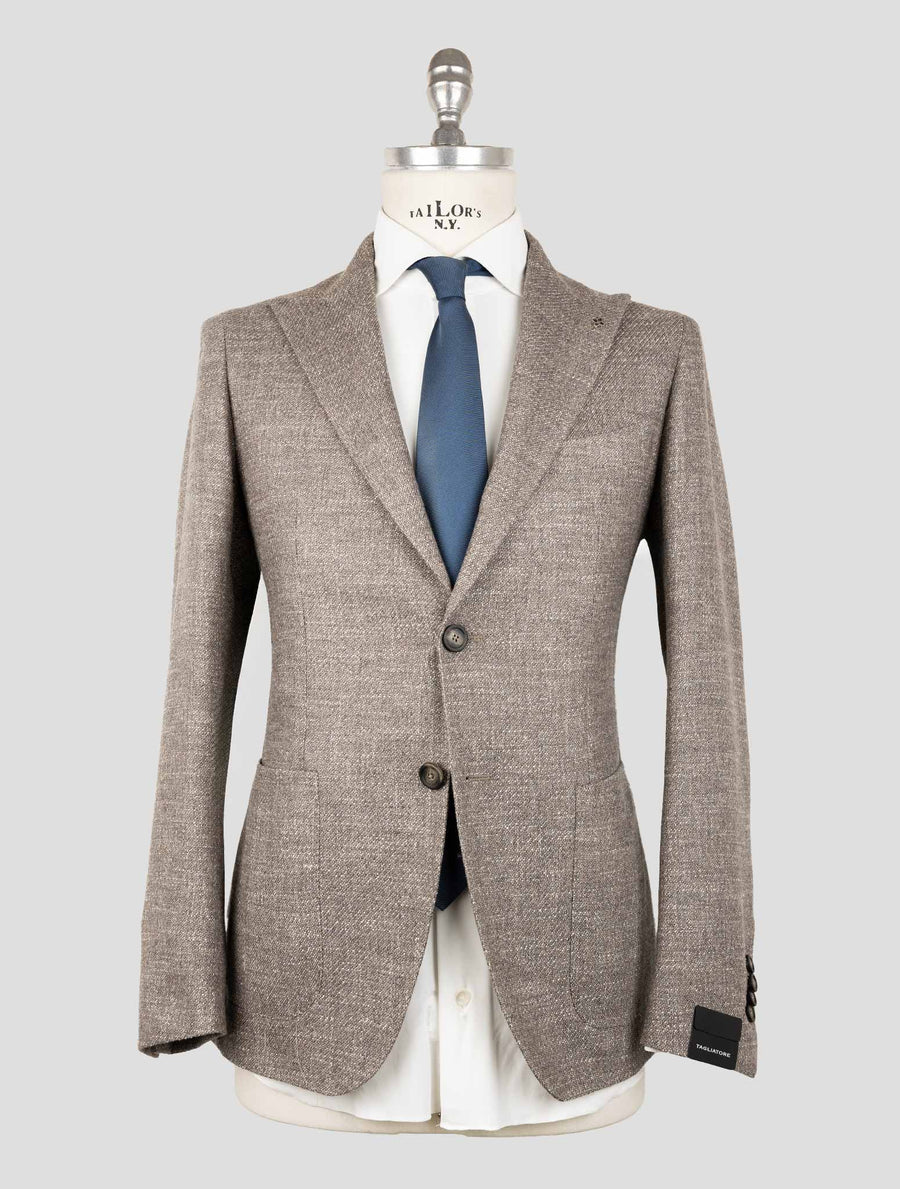
At the more rarefied end of the spectrum sits alpaca — a fibre prized for its extraordinary softness, thermal regulation, and the particular way it diffuses light to produce a surface that appears almost frosted in texture. Tagliatore's gray alpaca and virgin wool blazer harnesses this quality with characteristic restraint, producing a piece that wears across three seasons and refuses to look anything other than deliberate — whatever the occasion.
Construction Philosophies: Structured Precision vs. Neapolitan Softness
Italian tailoring has never spoken with one voice when it comes to construction, and that productive internal tension is precisely what makes it so compelling. On one hand, there is the structured tradition of northern Italian tailoring — sharp shoulders, defined chest, a silhouette that projects authority before its wearer has said a word. On the other, there is the Neapolitan school: the spalla camicia (shirt-sleeve shoulder) that ripples gently at the shoulder seam, the chest canvas floating rather than fused, the overall effect one of studied nonchalance that somehow manages to look more dressed than the stiffer alternative.
Kiton occupies a position at the pinnacle of the latter tradition. Produced in their Arzano atelier outside Naples, the Kiton blue wool blazer is constructed according to a process that involves dozens of hours of hand-stitching per garment. The result is a jacket that settles onto the shoulders with an almost gravitational inevitability — as though it were tailored specifically for the man wearing it. There is no stiffness, no imposition of silhouette; only a quiet, confident alignment of cloth and form.
Tagliatore takes a slightly different approach, marrying the softness of Neapolitan construction with the tonal restraint more commonly associated with continental Italian dressing. Their gray alpaca and virgin wool blazer exemplifies this balance: structured enough to read as polished in a business context, relaxed enough to work effortlessly across a weekend itinerary without a single alteration in styling approach.
Colour and the Architecture of Restraint
A wardrobe built around Italian blazers is, at its heart, a study in colour discipline. The Italian sartorial tradition has always understood that the most powerful palette is a narrow one — that a mid-navy, a warm beige, and a soft grey, chosen with precision and worn with conviction, will outperform an entire rainbow of reactive purchases. This is the logic behind the colour choices of the houses featured here, and it is a logic worth absorbing fully before making any acquisition.
Navy and its variants — from the deep midnight of formal dressing to the open, light-filled blue associated with summer tailoring — form the backbone of any serious Italian blazer wardrobe. The Isaia wool-silk-cashmere blazer in blue sits precisely in this territory: a tone deep enough to carry authority, light enough to remain approachable. Worn against white or pale blue shirting, with or without a tie, it produces an effect that reads as effortlessly correct across virtually every social context a contemporary professional might encounter.
Beige and warm grey operate at the opposite pole of this palette — providing relief, contrast, and seasonal variety. The beige of the Luigi Borrelli Procida 12 is particularly considered: warm rather than cool, cream-adjacent without being precious, it works against charcoal, navy, and even olive trousers with equal confidence. Meanwhile, the gray of the Tagliatore alpaca blazer introduces a silver-toned neutrality that functions as a sophisticated canvas for bolder accessories.
Four Italian Blazers Worth Owning
A curated selection — available now at IsuiT
-
Luigi Borrelli Blue Virgin Wool Blazer
Shop now: Luigi Borrelli Blue Virgin Wool BlazerRegular price €1.400,00 Sale price €450,00 -
Isaia Light Blue White Wool Silk Linen Ea Blazer
Shop now: Isaia Light Blue White Wool Silk Linen Ea BlazerRegular price €4.250,00 Sale price €1.700,00 -
Tagliatore Gray Virgin Wool Silk Pa Cashmere Ea Blazer
Shop now: Tagliatore Gray Virgin Wool Silk Pa Cashmere Ea BlazerRegular price €645,00 Sale price €387,00 -
Shop now: Kiton Blue Wool BlazerRegular price €4.845,00 Sale price €2.422,50
Hand-stitched in Arzano, Naples. Pure wool in refined navy-blue. The apex of Italian construction.



Dressing for Every Occasion: From Business to Smart Casual
The true measure of an Italian blazer's quality is not how it looks in isolation — it is how many different lives it is capable of living across a man's weekly schedule. The working week alone demands at least three distinct registers: the authority of a formal client meeting, the approachability of a collaborative afternoon, and the relaxed confidence of an after-work dinner. A single, exceptionally chosen blazer should be able to navigate all three without alteration beyond a change of trousers or a loosened collar.
The Isaia wool-silk-cashmere blazer is ideally positioned for exactly this range. Worn with a mid-grey wool trouser and a white poplin shirt, it delivers the quiet authority that a formal professional context requires. Remove the tie, swap the trousers for well-cut dark denim, and the same blazer shifts seamlessly into smart casual territory — the silk content giving the cloth a lightness that reads as inherently relaxed, even when worn over a simple crew-neck knit.
The Tagliatore alpaca blazer, by contrast, begins its working life squarely in the smart-casual register and ascends from there. Its gray tone and softly deconstructed build make it the ideal companion for a Saturday afternoon — worn over a roll-neck in autumn or a white linen shirt in spring — yet its quality of cloth and cut give it the density of presence needed to function at a dinner party or cultural event without looking underdressed. This adaptability is not accidental; it is the direct result of cloth and construction chosen with occasion-spanning versatility as the primary design criterion.
The Kiton Standard: What True Handcraft Looks Like
There are Italian blazers, and then there are Kiton blazers. The distinction is not one of degree — it is one of kind. Kiton remains perhaps the world's most uncompromising producer of hand-tailored menswear: a house where a single blazer may pass through the hands of more than fifty skilled artisans before it reaches its final form, where buttonholes are stitched by needle rather than by machine, and where fit is considered a non-negotiable starting point rather than a variable outcome. The Kiton blue wool blazer represents this philosophy in its most direct form — a statement piece that commands a room not through ostentation but through the unmistakable quality of its presence.
To wear a Kiton blazer is to understand, perhaps for the first time, what the conversation between cloth and body can actually feel like when it is conducted at the highest level of craft. The wool moves with the wearer; the shoulders settle without prompting; the chest neither pulls nor gaps. It is a piece that justifies the Italian tailoring tradition in every moment of its wearing.
Building a Capsule: How Many Blazers Does a Man Actually Need?
The honest answer is three. One for formal and business contexts — a structured or semi-structured navy or dark blue in fine wool or a luxury blend, such as the Isaia or the Kiton featured here. One for smart casual and transitional dressing — a soft, lightly deconstructed blazer in a neutral tone that can move between contexts without ever appearing out of place, fulfilled perfectly by either the Luigi Borrelli beige or the Tagliatore gray. And one wildcard — a piece in a more expressive texture, colour, or fabric that speaks to personal style and occasions outside the professional register.
What this means in practice is that quality will always outperform quantity. Two or three blazers from houses like those featured at IsuiT's curated Italian collection will serve a man's wardrobe more comprehensively than a dozen mid-market alternatives. They will hold their shape, their colour, and their structural integrity across years of regular wear — which is precisely the cost-per-wear logic that younger luxury consumers have already internalized, and that the broader market is steadily catching up with.
Care and Longevity: Preserving an Investment
A blazer constructed from fine Italian wool or an alpaca blend will not tolerate the same treatment as fast-fashion outerwear. Dry cleaning should be reserved for genuine necessity — excessive cleaning strips natural fibres of their oils and accelerates fabric fatigue. Between wearings, hang the blazer on a shaped wooden hanger wide enough to support the shoulder without distorting it. Allow the cloth to breathe for at least 24 hours between successive wears, and brush gently along the grain with a natural-bristle garment brush after each use to remove surface particles and restore the nap.
Storage matters too. Cedar blocks or sachets will protect against moths without introducing the chemical residue of synthetic alternatives. If storing for a season, use a breathable cotton garment bag — never plastic, which traps moisture and accelerates the deterioration of natural fibres. Treated with this level of attention, a Kiton or Luigi Borrelli blazer is not a five-year purchase — it is a wardrobe fixture for decades.
Frequently Asked Questions
What makes Italian blazers different from other European tailoring traditions?
Italian blazers — particularly those from Naples and the broader southern Italian tradition — are distinguished by their use of soft, unstructured or lightly structured construction techniques. The spalla camicia shoulder, floating chest canvas, and open-seam finishing create a garment that moves organically with the body rather than imposing a fixed silhouette. Northern Italian tailoring adds a degree of precision and structure that bridges the gap with Milanese and continental styles. Together, these traditions produce a spectrum of blazers unmatched for versatility and refinement anywhere in the world.
Which fabric is best for a first Italian blazer purchase?
Virgin wool in a mid-weight weave (around 260–310 grams per running metre) is the ideal starting point for most men. It offers year-round wearability across three seasons, holds its shape reliably, and is available in the full range of colours and weights suited to any occasion. The Luigi Borrelli Procida 12 in beige virgin wool is an excellent benchmark — a piece that delivers all the fundamental qualities of great Italian tailoring in a fabric that is as forgiving as it is refined.
Can an Italian blazer be worn with jeans?
Absolutely — and this is precisely where the best Italian blazers distinguish themselves most clearly from standard suit jackets. A soft-construction blazer in a neutral tone, such as the Tagliatore gray alpaca piece or the Luigi Borrelli beige, pairs exceptionally well with dark, well-cut denim. The key is to ensure the denim is clean, slim without being tight, and paired with a simple shoe — a leather loafer or a clean Oxford — that maintains the overall register of considered dressing rather than casual assembly.
Is the Isaia wool-silk-cashmere blazer suitable for business wear?
Yes — and it is one of the most versatile pieces in the Isaia range for exactly this purpose. The deep blue tone reads as authoritative in a professional environment, while the silk content in the blend gives the cloth a subtle luminosity that elevates the piece above standard business tailoring. Pair it with a white or pale blue shirt and tailored trousers in charcoal or mid-grey for a boardroom-ready look that never tips into the predictable.
How often should I dry-clean an Italian blazer?
As infrequently as possible. Professional dry cleaning should be reserved for genuine soiling that cannot be addressed by other means. For regular maintenance, a natural-bristle brush used along the grain of the fabric after each wear is sufficient to keep the cloth in excellent condition. Spot-cleaning with a damp cloth handles minor marks effectively. A quality Italian blazer in fine wool or alpaca will fare significantly better over time if dry-cleaning is treated as an occasional measure rather than a routine.
Where can I purchase these Italian blazers?
All four blazers featured in this guide — the Luigi Borrelli Procida 12, the Isaia wool-silk-cashmere blazer, the Tagliatore gray alpaca blazer, and the Kiton blue wool blazer — are available through IsuiT, a specialist Italian luxury menswear platform offering an expertly curated selection of the finest pieces from each house.


