

Italian tailoring offers the most refined vocabulary for this challenge. From the workshops of Naples to the fabric mills of Biella, the Italian tradition is built on the idea that clothes should honour the body, the season, and the context simultaneously. A suit cut from noble virgin wool, a shirt whose cotton breathes against the skin, a shoe finished by hand — these are not extravagances but investments in a version of yourself that rises naturally to the ceremony. This guide distills that tradition into eight clear principles for the contemporary man attending or presiding over a wedding.
"True elegance at a wedding is the art of being remembered as impeccably dressed without anyone being able to say precisely why."
Explore the full collection of Italian tailoring at IsuiT
1. Understand Your Role Before You Dress for It
The single most important question you can ask before selecting your wedding outfit is deceptively simple: what is my role today? The groom occupies a different sartorial position from the best man, who occupies a different position from a wedding guest. The groom has both the freedom and the obligation to express himself fully through his clothing — his suit is a statement, and that statement will be preserved in photographs for decades. For every other man at the ceremony, the imperative is to support the visual harmony of the day rather than to claim the foreground.
Italian tailoring understands hierarchy intuitively. The Neapolitan tradition, in particular, has always been attuned to context — a suit made for a formal luncheon is cut and finished differently from one intended for an evening gala, even when the cloth is identical. When you shop for wedding attire through a curated source like IsuiT's Italian tailoring collection, you are entering a conversation about appropriateness that the great houses have been refining for generations.
2. Choose a Suit Fabric That Honours the Occasion
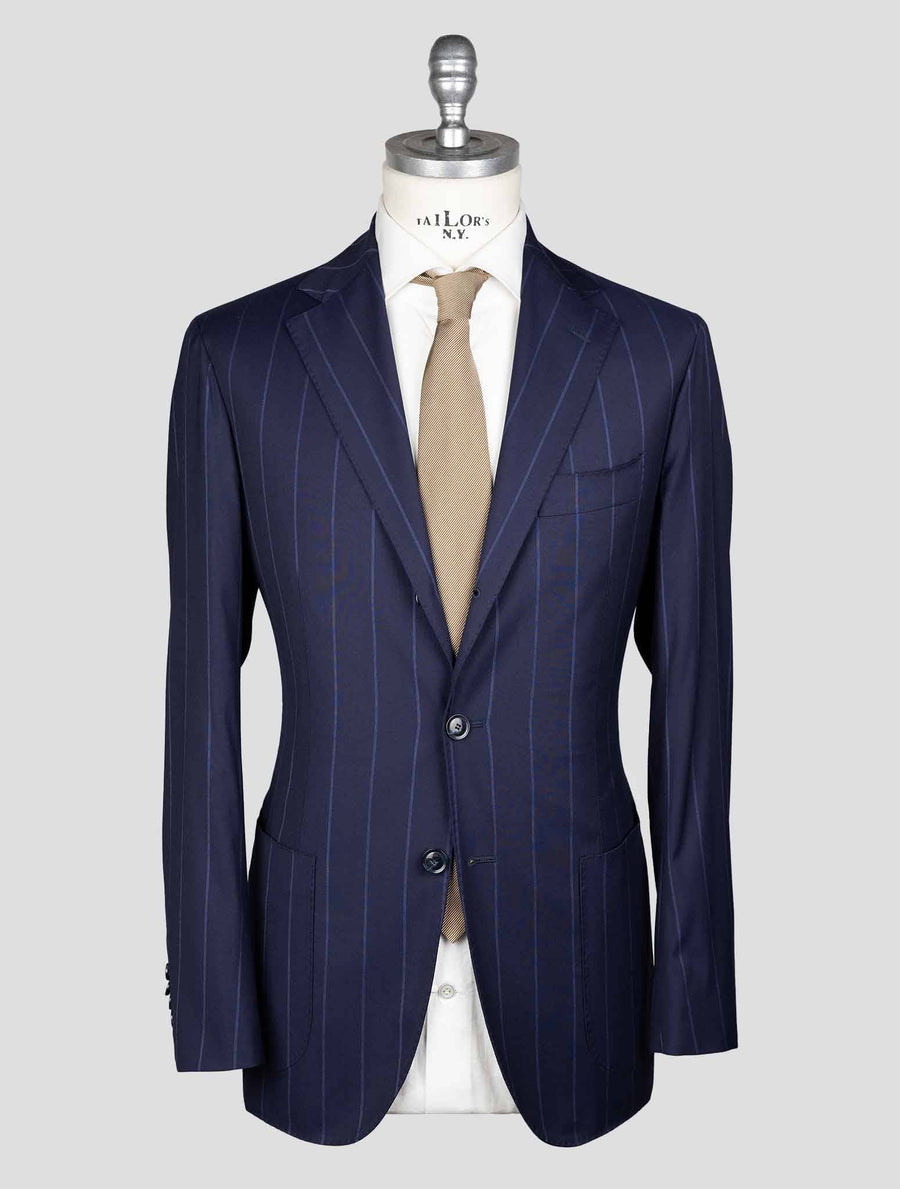
Fabric is the first decision, and it shapes every subsequent one. For a traditional church wedding or a formal reception, virgin wool remains the benchmark. It drapes with authority, holds its shape through hours of sitting, standing, and dancing, and carries a depth of colour that synthetic fibres simply cannot replicate. The Sartorio Napoli dark blue virgin wool suit exemplifies everything this fabric can achieve: the construction is Neapolitan in spirit, meaning it moves with the body rather than constraining it, and the deep navy reads as evening-appropriate from the afternoon ceremony all the way through the dinner that follows.
For late spring or summer weddings — particularly those held outdoors in Italian gardens or on Mediterranean terraces — a wool-viscose blend offers intelligent relief. The Sartorio blue virgin wool viscose suit strikes exactly this balance: the viscose introduces a subtle sheen and a lightness of hand that allows the suit to breathe in heat, while the wool content preserves the structured silhouette and the refined fall of the lapel. In tonal blue, it occupies the ideal middle register — formal enough for a ceremony, relaxed enough for a terrace aperitivo.
3. The Shirt: Where Elegance Becomes Visible
No detail undermines a fine suit more quickly than the wrong shirt. Italian tailors have always understood that the shirt is the closest layer to the skin and, by extension, the truest expression of personal taste. For a wedding, the white cotton dress shirt remains the most eloquent choice precisely because it does not argue with anything. It defers to the suit, amplifies the collar, and frames the face with clean, continuous light.
The Kiton white cotton shirt sets the standard in this category. Kiton's shirt-making atelier in Naples produces collars and cuffs with a precision that becomes apparent the moment you button the top button — there is no excess fabric at the throat, no pulling across the chest, no gap at the back hem when you raise your arms. Paired with either of the Sartorio suits, it creates the kind of composed, unhurried formality that photographs translate as effortless confidence.
4. The Four Pieces That Define a Complete Wedding Look
The Edit: Four Italian Essentials for the Wedding Season
-
Sartorio Napoli Dark Blue Virgin Wool Ea Suit
Shop now: Sartorio Napoli Dark Blue Virgin Wool Ea SuitRegular price €2.050,00 Sale price €1.435,00Neapolitan construction · Pure virgin wool · Deep navy Unlined chest · Spalla camicia shoulder
-
Sartorio Blue Virgin Wool Viscose Ea Suit
Shop now: Sartorio Blue Virgin Wool Viscose Ea SuitRegular price €1.700,00 Sale price €600,00Wool-viscose blend · Tonal blue · Lightweight drape Ideal for spring and summer ceremonies
-
KITON Black White Cotton Korean Shirt
Shop now: KITON Black White Cotton Korean ShirtRegular price €360,00 Sale price €180,00 -
Santoni Dark Brown Leather Suede Loafers
Shop now: Santoni Dark Brown Leather Suede LoafersRegular price €650,00 Sale price €325,00



5. Shoes: The Detail That Tells the Story from the Ground Up
Italian men have a phrase for the moment when a look fully coheres: la scarpa chiude tutto — the shoe closes everything. It is a philosophy rather than a fashion rule, and it explains why Italian shoemaking has always been considered equal in importance to tailoring rather than subordinate to it. For a wedding, the shoe must do several things at once: it must be formal enough to respect the occasion, relaxed enough to survive a long day on stone floors or garden grass, and refined enough to complement the suit without interrupting its line.
The Santoni blue leather and suede loafers navigate all of these demands with uncommon ease. Santoni, founded in the Marche region in 1975, remains one of the few Italian houses that still finishes its shoes entirely by hand — the combination of smooth leather and suede in a single shoe requires exceptional skill to execute cleanly, and the result is something that reads as both crafted and contemporary. Worn with the dark blue Sartorio virgin wool suit and the Kiton white shirt, they complete a chromatic story told entirely in blue and white, grounded in the finest Italian workshops from Naples to the Marche.
6. Colour Architecture: How to Read a Blue Palette
The decision to build a wedding look around blue is one of the most intelligent choices a man can make for this occasion. Blue occupies an almost unique position in the sartorial spectrum: it is simultaneously formal and approachable, authoritative and celebratory. Dark navy communicates gravitas; mid-tonal blue suggests warmth; the combination of both — suit in one register, shoe in another — creates the kind of layered, considered look that separates a dressed man from a man who simply owns clothes.
What makes the colour architecture of these pieces particularly successful is the way the textural variation works within the palette. The matte, deep navy of the Sartorio Napoli virgin wool suit absorbs light, creating a sense of depth and gravity. The suede panel of the Santoni loafers introduces a softer, brushed tone at the foot — a quiet echo of the suit rather than a direct match. The white of the Kiton shirt then provides the necessary relief, the clean break that prevents the look from feeling monolithic.
7. The Groom's Prerogative: Permission to Be Singular
Everything in this guide so far has been written with the wedding guest in mind — the man whose obligation is to honour the occasion through quality and restraint. But the groom occupies a fundamentally different position, and his clothes should reflect that. The groom may — indeed, should — choose something that speaks specifically to him rather than to a general standard of appropriateness. The Sartorio blue wool-viscose suit with its distinctive sheen and lighter hand is a compelling choice for the groom who wants to differentiate himself from his guests while remaining within the grammar of Italian tailoring. Paired with a contrasting pocket square in ivory silk or a lapel flower in white, it announces itself as a deliberate choice rather than a safe one.
For the groom who prefers an evening or autumnal ceremony, the full depth of the Sartorio Napoli dark blue virgin wool suit carries the weight of the moment with particular authority. Virgin wool in this depth of shade photographs beautifully under artificial light, and its construction — padded by hand at the chest, finished with a floating canvas — ensures that after eight hours of ceremony, photographs, and dancing, it still looks as though it was put on five minutes ago.
8. The Invisible Architecture of a Perfect Wedding Look
There is a category of detail in men's dressing that operates below the threshold of conscious observation but that registers nonetheless — in the impression you make as you cross a room, in the photograph taken at the wrong moment that still looks right. These are the details that Italian tailoring has always understood as primary rather than secondary: the way a collar sits against the neck, the precision of a breast pocket, the fall of a trouser over a well-made shoe.
When these details are resolved — when the Kiton white cotton shirt sits flat beneath the lapels without bunching, when the trouser break rests exactly at the vamp of the Santoni loafer — the overall effect is one of effortless composure. This is the Italian idea of sprezzatura at its most literal: the appearance of ease that is the product of great care. It is the quality that makes Italian wedding style for men something more than a dress code. It is a practice of attention, and the finest Italian houses have spent generations perfecting its materials.
Frequently Asked Questions
What is the most appropriate suit colour for a wedding guest?
Deep navy and tonal blue are the most versatile and appropriate choices for a male wedding guest. They read as formal and celebratory without risking competition with the wedding party. Both the Sartorio Napoli dark blue virgin wool suit and the Sartorio blue wool-viscose suit offer distinguished interpretations of this palette for different seasons and times of day.
Should a wedding guest wear the same suit as the groom?
There is no strict prohibition, but it is worth making a phone call. The groom's suit is generally a more personal and deliberate choice, and arriving in an identical garment — particularly if the silhouette and colour are very close — can create awkwardness in the photographs. If you discover you have both chosen, for example, a Sartorio Napoli suit in dark blue, varying the shirt or shoe choices will distinguish the two looks adequately.
Are loafers acceptable at a formal wedding?
A well-crafted loafer is entirely appropriate at a contemporary formal wedding, particularly in the Italian tradition where shoe formality is assessed by quality of construction and finish rather than by style alone. The Santoni blue leather and suede loafers represent exactly this position — they are hand-finished to a standard that comfortably matches the formality of a Sartorio suit, and their sleek profile carries none of the casual associations of a cheaper slip-on shoe.
What fabric should I choose for a summer wedding?
For warm-weather weddings, prioritise fabrics with natural breathability and resistance to creasing under heat. A wool-viscose blend — as found in the Sartorio blue virgin wool viscose suit — is ideal: the viscose content lightens the fabric and allows air to move through it, while the wool preserves the structured drape and the depth of colour. Avoid pure linen for the most formal ceremonies unless the dress code explicitly permits it.
How important is the shirt at a wedding?
The shirt is arguably the most important single garment in a wedding look because it is the one piece that frames the face in every photograph. A white cotton shirt with a well-constructed collar and precise fit — such as the Kiton white cotton shirt — anchors any suit combination and ensures that even candid photographs read as considered and composed. It is the one item on which there is no case for compromise.
How does Italian tailoring differ from British or American tailoring for weddings?
Italian tailoring, particularly in the Neapolitan tradition, is distinguished by its emphasis on natural movement and the unstructured shoulder. Where British tailoring tends toward a more padded, formal silhouette appropriate for cooler climates and conservative occasions, the Neapolitan approach creates a jacket that sits on the body with almost shirt-like ease. This makes it particularly well-suited to outdoor summer weddings and to extended celebrations where you need to feel as comfortable after dinner as you did during the ceremony. The construction techniques involved — floating canvases, hand-stitched lapels, spalla camicia shoulders — are more labour-intensive than machine methods, and the difference in how the garment wears over a long day is immediately apparent.


